Sunday, November 22, 2009

Anne of Green Gables by L.M. Montgomery


From the favourer: "The Anne novels cheer me up when I'm feeling generally depressed about life. Nothing bizarre happens in Anne's life: she grows up, marries a doctor, has SEVEN children, she grows old, she has a garden bed, and a home she loves. All her happiness comes from inside her. I think maybe it reminds me that ordinary life is full of adventures and things to be happy about."

I think I first read the Anne books at around the same time as the favourer, as I recall much discussion of Daisy and Dora (from the later books). Were we about 12? Something like that. We then sallied forth to hunt down every book by Lucy Montgomery that the Corangamite Regional Library Service could provide. What a joyous few months! We must have come out the other end having experienced the word 'purple' far more often than your average reader.

But I'm pretty sure I hadn't read it again since then, though I've re-read the Emily books many times. I think with Montgomery's novels you end up being an Anne Person or an Emily Person (it's possible there's a Pat of Silver Bush Person out there, but they'd be a rarity). It's a bit like being a Dog Person or a Cat Person. So I'd quite forgotten a lot of the detail of Anne of Green Gables. But I can honestly say I re-read it with unabashed, whole-hearted, unembarrassed delight.

While it's probably unnecessary, I should give a bit of a synopsis. I suppose there may be 1 person left in the world who hasn't either read the book, seen a movie adaptation, or had someone tell them what the book is about. But I suspect most people are born knowing the basic plot - the knowledge passes from mother to child with the amniotic fluid.

Siblings Marilla and Matthew Cuthbert decide to adopt an orphan child - a boy - to help with the farm work at Green Gables. Their neighbour, Mrs Rachel Lynde (who knows everybody's business and is happy to give advice about it), cautions against it:

"'Only don't say I didn't warn you if he burns Green Gables down or puts strychnine in the well -I heard of a case over in New Brunswick where an orphan asylum child did that, and the whole family died in fearful agonies. Only, it was a girl in that instance.'
'Well, we're not getting a girl,' said Marilla, as if poisoning wells were a purely feminine accomplishment and not to be dreaded in the case of a boy."

But when Matthew goes to collect their orphan boy, he discovers that they have been sent a very talkative, very red-headed, very female girl:

"A child of about eleven, garbed in a very short, very tight, very ugly dress of yellowish white wincey. She wore a faded brown sailor hat and beneath the hat, extending down her back, were two braids of very thick, decidedly red hair. Her face was small, white and thin, also much freckled; her mouth was large and so were her eyes, that looked green in some lights and moods and grey in others. So far, the ordinary observer; an extraordinary observer might have seen that the chin was very pointed and pronounced; that the big eyes were full of spirit and vivacity; that the mouth was sweet-lipped and expressive; that the forehead was broad and full; in short, our discerning extraordinary observer might have concluded that no commonplace soul inhabited the body of this stray woman-child..."

He can't exactly leave her there at the train station, so Matthew takes her home to Green Gables. Marilla is horrified, and resolves to rectify the situation as soon as possible. But on learning of Anne's probable fate she has a change of heart, and the girl is allowed to stay at Green Gables.

Marilla intends to bring her up properly, but Anne is not like any other child she's met before: Anne has an imagination. She talks a mile a minute, uses big words, and forgets to do her chores because she was making friends with the fir trees. Marilla can't understand her, and Anne is equally bamboozled by Marilla's attitude to life:

"'Do you never imagine things different from what they really are?' asked Anne wide-eyed.
'No.'
'Oh!' Anne drew a long breath. 'Oh, Miss - Marilla, how much you miss!'"

What follows is Anne's youth at Green Gables - mostly full of scrapes: accidentally dying her hair green, flavouring a cake for the new minister with liniment, and the notorious breaking of a slate over the head of Gilbert Blythe (it's at about the 1min40sec mark for the watchers). But it's also full of joys: finding 'scope for the imagination' in the small town of Avonlea, and 'bosom friends'. Anne and her friends even have their own version of NaNoWriMo called "The Story Club", where each member has to produce one story a week. They are thrilling tales, of course, with lots of murders and romance: "Aunt Josephine wrote back that we were to send her some of our stories. So we copied out four of our very best and sent them. Aunt Josephine wrote back that she had never read anything so amusing in her life. That kind of puzzled us because the stories were all very pathetic and nearly everybody died."

It's funny, touching, beautiful and just a delightful read - Montgomery's descriptive prose is quite purple (often literally so - sometimes even 'empurpled'), but it's in the spirit of how the romantic Anne sees the world. Reading this book also seems to have had an effect on my dress sense - I've found myself wearing many more frilly things than usual. And don't talk to me about puffed sleeves.

I think you can learn a lot from Anne. When forced to do something humiliating (such as apologise to Mrs Lynde as punishment for a justifiably angry outburst), Anne turns the humiliation into something pleasurable by performing the most dramatic, sincere and flowery apology she can muster. The "Good Mrs Lynde, not being overburdened with perception", is quite touched and accepts her apology immediately, but Marilla is left with the faint sense that Anne hasn't been punished at all. Moral of the story: If you can't avoid having to do something unpleasant (or 'tragical', as Anne would say), you can at least enjoy the very drama of the unpleasantness. Mrs Lynde would whole-heartedly disapprove of this 'lesson', which makes it all the more appealing.

But despite her swings between delight and despair, Anne has a general talent for happiness. It comes, as the favourer notes, from inside her. She takes enormous joy in small moments (flowers, weather, gifts), and is full to the brim with dreams and ideas. She's irrepressible, and her joy rubs off on others. She's no Pollyanna though: "There's such a lot of different Annes in me. I sometimes think that is why I'm such a troublesome person. If I was just the one Anne it would be ever so much more comfortable, but then it wouldn't be half so interesting." Indeed. I can think of nothing more boring than a perfect Anne.

I finished reading Anne of Green Gables while Luka slept and the long, hot week of 30+ degree November days broke into a drench of steady rain. I sat on the shared balcony above our flat with a mug of tea and watched the lovely downpour cool the trees, while Anne watched the sun set in Avonlea:

" 'Dear old world,' she murmured, 'you are very lovely, and I am glad to be alive in you.' "


Thursday, November 19, 2009

Laydeeeees and Gentlemen! The Port Fairy Hospital Fundraiser

Our family friend and artist Jenny McCarthy runs a fundraiser every 2 years for the Port Fairy Hospital. In case you think that Port Fairy is merely the home of the Folkie (or Port Fairy Folk Festival to the uninitiated), let me enlighten you. Port Fairy is actually excellent all year round. Not only does it have beaches, lovely places to eat (some of them get hats), shops where you can happily spend much more than you meant to, it also has (wait for it) a community.

And Jenny is up there in it. The idea of the fundraiser is for friends, family and willing aquaintances to produce a painting to auction, and this year a teapot to go with it:


Some of the people who provided art are actually proper-like artists. Some of them are not. I'm certainly not. Not only did I have to buy some paint to make my canvas, I had to buy a brush too. Still, this was my effort (called "Artistree", painted on curtain fabric):


I was, however, especially proud of my teapot (I called it "Treepot"):


Took me back to my high school days of gluing stuff together with superglue (mostly my fingers).

The canvases and accompanying teapots are auctioned in ye olde Dutch style (ie. there's a bit of paper and a pencil hanging from each painting, and you write down your bid, then someone might outbid you, so you have to come back in between glasses of fizzpop to check you haven't been outbid, and if you have, you bid again with your pencil. It's like eBay, but with more walking).

I left the boy at home with his dad and enough milk in the fridge to sustain twins for a week, and we wimmin toddled off to Port Fairy. Here are the Punch girls with our art (my mum Jude, me, and my aunt Margy):

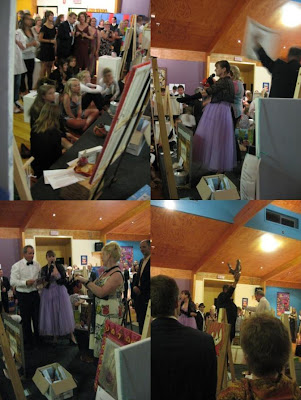
We arrived pretty early at the hall, but people swished in fast. Everyone had dressed up, and swilled about looking at the paintings on offer:

Jenny, in her awesome lilac ball gown, announced that there would be lucky door prizes:

I was especially hoping to get my hands on the National Bank bag, but had no joy. There's a lucky person out there. You know who you are.

We all kept running back to our paintings to see if we'd had any bids (especially exciting when someone you DIDN'T KNOW bid on your painting!). But at some point, this teapot arrived on the scene:

It's a squid, obviously. It's just a very *ahem* well-endowed squid.

After the crowd was well lubricated (and it WAS a crowd, by this point, there was the occasional CRASH as someone's painting was elbowed off an easel and onto the floor), the auction began. Several works by the proper-like artists were to be auctioned off in the round by Mr 'sales' Simon Bones, an auctioneer at the local sale yards. This ain't your mother's Sotherbys.


It's much more exciting. Actually, it was REALLY exciting. The crowd got noisier with every auction, and despite the $5 in my pocket I nearly bid on something after the $900 mark. Can you bottle that sort of atmosphere? Perhaps not. But if you can make it through 4 minutes of the following video, you'll see what I mean:


The kids sat on the floor (and nicked the occasional glass of wine), the crowd gathered round and round and between auctions we ran back to our favourite paintings to see if we'd been outbid.

Those of us who had provided paintings ran back to our own work to see if we'd been bid any higher.

One of the most delightful things about the evening was seeing the love that the Port Fairy community has for Jenny. I eavesdrop a LOT, and if the Port Fairy Hospital got a dollar for every lovely thing that was said about her that night, well, they wouldn't have need of a fundraiser at all. It's not hard to understand: she's ace.

But obviously, you're wondering about how much the Punch Family Art raised for the hospital. Here are our bidding cards for your perusal:


My aunt Margy won out with $175, my mum Jude came in next with $120 (and of course we have no acquaintance with Ashley, though he's got a fine eye for an artwork), and yours truly brought up the rear with $52.

And it wasn't even my mum who bought my painting.


Monday, November 16, 2009

Free book, anyone?

I've got a couple of books to give away, ones I've blogged about one here. I like to spread the love.

Would you like a free (secondhand, in a couple of cases third/fourth-hand) copy of:

Dragons of Autumn Twilight - Margaret Weiss and Tracy Hickman

I've got 1 copy of each to give away. I've registered them on Bookcrossing to track their travel.

Email me which one you'd like at greenknowe@hotmail.com, or DM me on Twitter, or tell my mum you'd like it, and I'll send it to you.

The early bird catches the book. If they're not claimed in a week, I'm releasing them into the wild!

_____________________

* Update - D.A.A.S Book has been claimed! Get in quick for the other two, people.
** Update - Dragons of Autumn Twilight has been claimed! One book left...
***Update - A Suitable Boy has been claimed! Enjoy your books :)

Wednesday, November 11, 2009

Mrs Frisby and the Rats of NIMH by Robert C. O'Brien

From the favourer: "37 years of primary school teaching inevitably led me to reading an enormous number of novels as serials to my classes. 'Mrs Frisby and the Rats of NIMH' stood out as my own personal favourite, as well as being the favourite of many of the listeners. It's funny how a kid's book can end up as an adult's favourite...perhaps this is a statement on the teacher concerned?"

Given the amount of children's books that have turned up on this list of favourites, it's not uncommon for an adult's favourite book to be a book written for children. And given the amount of beautifully crafted nothings that circulate on the adult literary circuit, I think it makes sense for everyone's favourite book to be a children's book. Sorry, ranting. I'll stop now.

Mrs Frisby, a recently widowed mouse, lives during winter with her four children in a cement block buried in a wheat field. Each year when the thaw comes, the family move to their summer house away from the field, to avoid being chopped up by the farmer's plough. But this year, something is different. Little Timothy has had a close brush with pneumonia, and any exposure to cool air, even as the days temper towards spring, will be the death of him. When by chance Mrs Frisby saves the life of a crow, he offers to repay the favour by flying her to meet the wise old owl. The owl is initially unable to offer any advice about Mrs Frisby's situation, but when he learns that she is the widow of Jonathan Frisby, his manner changes. He suggests that she goes to see the rats that live in the rosebush. Mrs Frisby is puzzled - how could the rats help, and what do they have to do with her husband?

But these are no ordinary rats. Ordinary rats don't move in formation, work with electrics, and they certainly don't read. And their secret is bound up with Mrs Frisby and her family.

I first read Mrs Frisby and the Rats of NIMH in grade 3, and remember being fascinated by the story of the rats, and wondering vaguely why Mrs Frisby was in it at all. Later I saw the animated film, which was great, but completely shifted the focus from the rats to Mrs Frisby's story. Which probably made for a good film, but it was really the rats that intrigued me, and probably many other readers.

Robert C. O'Brien intended to become a professional pianist (don't we all), but after working at a boys' summer camp as a student he learned about stories, and storytelling. He 'found that in the dark you don't read stories, you tell them, and this is the best training of all for learning what kinds of stories children like'. Later he worked as a newspaper reporter. When you read his fiction, you can see the influences of these two experiences on his writing - he writes a damn good story, and he writes it economically.

Mrs Frisby and the Rats of NIMH is only 197 pages long, and there is not a single word wasted. It's pared-back, story-driven writing where every word works carefully to build tension, character and plot. There's no fluff. No wonder it worked well as a classroom serial. It's a killer story, and every time my baby woke up from a nap and I had to stop reading, I did the thing where I walked down the hall s-l-o-w-l-y to the nursery, still reading, to get a few more lines into those 10 steps. It's also a very serious book. There's the odd moment of dry humour:

' "When we don't know what to do, we ask [the owl]. Sometimes he answers our questions, sometimes he doesn't. It depends on how he feels. Or as my father used to say - what kind of humour he's in."
Or possibly, thought Mrs Frisby, on whether or not he knows the answer.'

If you've seen the movie, there's quite a bit of hilarity injected into the story, mostly via the crow Jeremy (who is an absolute riot in the movie, by the way. "OOH, A STHPARKLEEEEE"). In the book he's a minor character, almost a plot device, barely curling out a couple of chapters. He's certainly not the comedic foil of the movie:


But draw of the story is really created by the rats - their capture, the experiments performed on them at NIMH, and how this lead to their new life (and their aspirations for a rat utopia). I think it's why O'Brien won the Newbery Medal for this book in 1972 (won this year by Neil Gaiman's Graveyard Book). The science in the novel is vague enough not to date, but specific enough to be believable, and the way O'Brien builds the tension of their story is perfect. Even if you've never felt sympathy for a lab rat running a maze, you will after reading this book:

'I never got used to that feeling - no one ever does - but I did experience it many times, and eventually learned what it was: electric shock. It is not exactly a pain, but it is unbearable...You might ask: Why would I bother to run through it at all, if I knew it was only a trick? The answer is I couldn't help it. When you've lived in a cage, you can't bear not to run, even if what you're running towards is an illusion.'

A part of this book I really hadn't remembered is the emphasis on reading and the impact that being able to read and write has on a person (or rat). Reading can be a way of growing, escaping, but the knowledge it provides imposes new limits on the reading animal. The rats experience this in a fundamental way: 'By teaching us to read, they had taught us how to get away.' This sentence is embedded in the story, but it resonates above the literal sense it has here. The rats are liberated by their ability to read, but it also puts them in danger. They are different, and they need to adapt to manage their difference in the world. They also need to manage the heightened moral awareness that their knowledge provides.

That's a lot for a nine-year-old reader to take in. And I didn't, then. But it says a lot that this slim volume can provoke those sort of thoughts for me, 20 years after I first read it.

And also, it's such a damn cracker of a read.

Tuesday, October 20, 2009

A Suitable Boy by Vikram Seth


From the favourer: "My criteria for favourite book is that I weep when I've finished because I feel like I've lost a friend. This is a rare event. 'A Suitable Boy' has lived with me every day since reading it."

I've been reading this 1474 page book since a week before Luka was born - so basically, my whole life.

It's been propped up against the couch for hands-free reading-while-feeding, back in the days where he took more than 5 minutes to feed. It's been carried about in the pram basket so that when Luka went to sleep I could stop, have a coffee and a bit of a read. It's been lugged in my handbag to read on the train on my first night out sans baby (though I had to take everything else out of my handbag to fit it in). It's been removed from being propped up against the couch because at 4 months Luka found the cover fascinating and was much more interested in touching the book than having a feed. And it's been discovered by a now-mobile 9 month old, and gently but effectively chewed.

And now I've finished reading it, I'm at a bit of a loss. What do I do now?

Oh yes: blog. Right.

I have an (apparently) shocking tendency to have a shifty at the last page of a book before I start reading. Before you strangle me with my own impatient stockings, I've found that the last page of a book doesn't usual spoil much. Killers or secret lovers aren't revealed on final pages. But I now have a solid defence for my back page habit. When I checked out the last page of my second-hand copy of A Suitable Boy, I discovered it looked like this:


The ARGH is mine. If I had discovered this only after 9 months of reading, it would have cast a somewhat pissed-off pall over my reading experience. Whether anything important happened or not, when a book is this long you really want to be able to read the last paragraph. So I got another copy out of the library, photocopied the missing bits, and glued them in:


While my patchwork makes reading the final pages a bit like Tetris meets Choose-Your-Own-Adventure, at least the words are there now.

When I first picked up A Suitable Boy, I just knew the blurb was going to describe it as "sweeping" (it does). This generally means "long". But although it's long, I'm not sure that "sweeping" really applies - this book doesn't sweep; it luxuriates, explores, satirises, exasperates, bores, amuses and moves. It doesn't sweep, it envelops. You don't really read A Suitable Boy, you kind of live with it.

Set in 1950s India, A Suitable Boy follows the interactions of four families, at the heart of which is Mrs Rupa Mehra's search for a suitable boy to marry her daughter Lata. But that is hardly the only subject of this 591,552-word beast. It navigates post-independence political changes, land reforms, spiritual conversions, riots and disasters, shoe-making, university machinations, rhyming couplets, and births/deaths/marriages, all as they relate to the four families. It's not a book you can keep in your head all at once, it's more like a long-running tv series. There's a cast of thousands for one thing - one reviewer described it as Middlemarch multiplied by Bleak House - and if it was any shorter you'd be really confused. As it is, the length of it means you end up working out who everyone is, and remembering, well, most of them.

Also like a long-running tv series, for parts of it I was really involved: laughing, crying, horrified and intrigued, and for parts of it I was tuned out - I found the extended courtroom scenes incredibly tedious and took to skipping them (very naughty, but I'd just had a baby so cut me some slack).

I've come out the other end of this book - bedraggled and a bit dazed - as part of the families. I'm in on all the family jokes (Kakoli-couplets, what it means for a car to be 'Kuku-ed', Mrs Mehra's diabetes diet that alters conveniently according to the quality of the food), and I have my 'favourite family' (the hilarious Chatterjis: "an intelligent family where everyone thought of everyone else as an idiot").

I found Seth's playful sense of humour completely appealing, and kept folding down page corners to remind me to quote them here. Unfortunately, there were so many that my book looks like a bit of a concertina at the bottom.

Some are just asides:
"The conversation ranged from politics…to English literature (where, with a few misquotations, Haresh asserted that Shakespeare had been written by Shakespeare)..."

Some play on expectations:
'The rickshaw-wallah said: 'It was a nice town – before the cinema-hall was built. Now what with the dancing girls and singing girls on the screen and all that loving and wiggling and so on' – he swerved to avoid a pot-hole in the road – 'it’s become an even nicer town.'"

And some are just funny exchanges between people who know each other very, very well:
"'You seem very well,' said Savita.
'Except I’m not,' said Maan. 'I fall upon the knives of life, I bleed.'
'Thorns,' said Pran with a grimace.
'Thorns?'
'Thorns.'
… 'Anyway, I’m going to send her a note today. I’m going to threaten to end it all.'
'End what all?' said Pran, not very alarmed. 'Your life?'
'Yes, probably,' said Maan in a doubtful voice. 'Do you think that’ll win her back?'
'Well, do you plan to back up your threat with some action? To fall upon the knives of life or shoot yourself with the guns of life?'"

Seth loves wordplay, snippets of which litter the pages. One character suspects he is a "mere meddler among Mehras", another, "being a bit of a layabout, he lay about a bit."

There are digs at writerly types: "He's just a writer, he knows nothing at all about literature." Amit the poet seems based on Seth himself, and expresses his difficulty with writing (one I'm familiar with): "I often like my work when I'm done - it's just the doing that is so tedious."

And Mrs Mehra provides constant and indignant comic relief. At one point Lata tries to reassure her of the innocuousness of a prospective night out:

"'Nothing to worry about. There’s just a large crowd and a band and dancing.'
'Abandoned dancing!' Mrs Rupa Mehra could hardly believe her ears."

These sorts of exchanges are just so much fun. But the other side of being so involved with these families is that you get attached to them. You become part of the chain of family that Seth evokes so simply with an image of relatives leading each other, hand in hand, through a crowd of people: "She, her son, his sister, her husband, and his mother – a chain of love, and consequently, of fear". When there are riots, disasters and injuries, you worry about the characters (and worry about what might get up to when you're not reading).

In the hazycrazy of a new baby, I've found it a relief that there was always more of this book to get through - as I neared the end a few days ago I started to get panicky. It was like the last season of Buffy all over again. There's not going to be any more!

But apparently there is going to be more - a sequel is in the works, due out in 2013. Having had a baby boy along with A Suitable Boy, I really should have another child - a girl - to coincide with A Suitable Girl.

How very suitable.

Sunday, September 20, 2009

Letters to myself


I've kept a diary since I was 9 years old. I've always called it a 'diary', but like the rest of my writing my diary-keeping has been neither prolific nor regular. The result is a somewhat erratic record of my life from 1989 to present, culminating in this handy 14 volume set (pictured right).

But more memorable (and easier to heft) are my letters to myself. When I was 12 years old, I wrote a letter to my future 18-year-old self, sealed it, and tucked it away in my 1992 diary. I remembered this first letter every now and then over the next 6 years, but didn't open it until I was 18. The act of writing the letter wasn't an original idea on my part - I ripped off the idea from L.M. Montgomery's Emily of New Moon (in fact, I plagiarise Emily twice quite shamelessly in my letter, which readers familiar with the Emily books will have to excuse). But I think the act of keeping the chain of 6-yearly letters going is mine.

This is my letter:

It reads:

"Dear Eighteen,

How is year twelve? Year seven is very easy. You'll have to excuse all these mistakes, the correction tape on the type writer has just run out on the last letter I wrote.

The end of term social was on last Wednesday, and Nilumi and I went as Yin and Yang. Are you still friends with her? Do you still want to be a vet?

I hope you're not laughing at me. Don't be all stuffy, be dramatic and romantic, I love those things.

This writing paper will have long run out by the time you get this. Do you still keep a diary? I am on my one with the cherubs kissing. It's quite small.

Pete has brought home a gym mat and a trampoline for me to do gymnastics on when I feel like it.

Do you still love Alice Anne? I hope you write a great book soon! Hey, do you have a car? A mazda 121? I doubt it. You probably have a beat old minor or something.

Do you have a boyfriend?

You had better still love reading. If you don't then I don't know you very well at all.

I give you a handful of moonshine, ten kisses and the soul of a leaf from a chinese tree, I hope you Haven't quite forgotten your foolish Old Self xxooo"

I love this letter. I love the blend of mundane fact (the expired correction tape, the new diary that is 'quite small'), floweriness and curiosity ('Do you have a boyfriend?' gets a line all to itself). I love my own assumptions that I'll be able to drive and that I'll be heterosexual. I love my own mixed ambition to be a vet who writes great books. I love that I am still friends with Nil, and that I sold Alice Anne (a porcelain doll) on eBay.

At 19, I wrote another letter to myself as a future 24-year-old:

It's a somewhat different letter, and no longer nicks phrases from other books. Actually, it does nick one, but I meant it as a reference - no, really I did. But the tone is the same - curious, passionately encouraging and unflinchingly sentimental and earnest. Before I wrote this blog I wasn't going to transcribe it, as the last time I read it a few years ago I thought it was still a little too close to home. But on reading it again, I've changed my mind (though a couple of paragraphs of it I'll omit to protect the innocent).

"Dear Twenty-Four,

My, how you've grown! I sit here, your nineteen-year-old self, propped up in bed on a soft warm night. The window is open, and breaths of cool air are rolling occasionally across my arms. It's the right sort of time to address the future.

There are so many questions. By my calculations, you must have finished your Arts/Science degrees last year - and now - ? Are you doing an honours year? Or have you launched into the wide world of work? I'm presuming you left UC [residential college] eventually, and have found yourself a flat. Do you live with someone? A boyfriend?

Are you still friends with dear Laura? And what about Nil and Mara? There's too many questions to ask.

Do you still keep a (rather erratic) diary? Do you still have a passion for children's literature and cappuccinos?

But most, most, most importantly - are you still getting closer to being that person you always dream of being? You'll get there, my dear, don't let yourself sink into ever thinking you won't. Your life is yours to play with. Your family love you, you've a brain in your head, you're not dying of cancer (yet - ha ha), and you can write well enough to get better and better. I just know you're going to learn and learn and learn until it lifts you beyond what you only dream you can do. Cling to that.

Do your remember you once told me you had decided to be an extraordinary person? Keep doing it. Sink your teeth into every opportunity and take on the whole bloody world, my girl. You're the luckiest woman I know. Think about it. This is the point of Babette [quote from Don Delillo's White Noise]. Things go right for you - always have.

Now look out the window, remember Emily of New Moon, and drag out the wild, dramatic poet in you. Take her for a run over the other side of the Hopkins, and keep working towards being that extraordinary person you want to be. Be romantic, never lose that to mere reality. Do what you've always been able to do - glory in small happinesses, and never forget me.

Because I am rather fond of you.

Smile for me, for the memory of

your affectionate,

Self xx"

I love this letter too, and it gives me the same mixed feelings of love, embarrassment and inspiration. I love that I still make assumptions, and that I'm still so ruthlessly supportive of my future self. I love that I am still friends with dear Laura, Nil and Mara. But most of all I love the fondness I feel, both as a 19-year-old looking forwards, and as a 29-year-old looking backwards at myself.

Tucked away in my 2006 diary is another envelope:


To Anna at Thirty-Two, From Anna at Twenty-Six. Plus cocktail stickers. It's still sealed, of course.

I've got no idea what I wrote in there. Every time I write one of these letters, I think I'll remember what I've written, and I never do. I guess 6 years is a long time.

But I can guess that when I'm 32 and I break it open, I'll smile, squirm with embarrassment, probably go a bit misty,

but still feel very affectionate towards my

funny

old

Self

Tuesday, August 11, 2009

The belated rabbit

A belated and lovely message from the favourer of The Velveteen Rabbit:

"I love the book because I feel like that rabbit (especially at my age and having been surrounded by and engaged with so many kids who sing Apples and Bananas and get jokes, have a vocabulary, and aren't afraid to make up a poem). I also like it because it gives dignity to those on the "scrapheap." It shows how they weren't always there and that we all one day will be there."

I was actually singing Apples and Bananas to Luka yesterday morning.
His favourite is the "oo" verse.

Ooh look to oot, ooh look to oot, ooh look to oot, ooples and banoonoos...